Persian Rugs in Contemporary Interior Design: Lessons from the Farshman Book
A minimalist room can look perfect in a render and still feel cold in real life. Concrete, glass, pale plaster and oak are calm and precise, but they offer very little warmth, softness or sound absorption. One of the oldest tools for fixing that is also one of the most beautiful: the handwoven Persian rug.
Our studio contributed 3D artwork to Farshman: The Aesthetics of Persian Carpet in Today’s Interior Design of the World, a book published by the Iran National Carpet Center in 2017. This article draws on what that book shows, and on the design thinking behind it, to explain how a Persian rug can anchor a contemporary interior rather than simply decorate it.
In short
- A Persian rug can act as a spatial anchor: it groups furniture, defines zones in an open plan and brings texture to hard materials.
- Starting from the rug is often the easiest way to build a room: its colours can supply the whole palette.
- Size and position matter more than pattern. The rug should be large enough for the main furniture to sit on its edges.
- Urban weaves and tribal weaves suit different interiors, so the style of the room should guide the choice.
Project at a glance
| Book | Farshman: The Aesthetics of Persian Carpet in Today’s Interior Design of the World |
| Publisher | Iran National Carpet Center, Tehran, Iran |
| Year | 2017 |
| Format | 188 pages, printed in a run of 1,000 copies |
| Our role (Charisma Space) | 3D artwork for the book’s interior presentations |
| Subject | Using handwoven Persian carpets and kilims in contemporary interiors around the world |
About the book
Farshman is a visual guide rather than a technical manual. Its main chapters, Interiors, About Beauty, About Principles, About Design and About Decoration, move from the elements of interior design to practical advice, and are followed by a Rug Index that names the regions and weaves shown. Each interior spread follows a simple key: the main presentation of the room with its rug, a colour panel, a plan showing where the rug sits, and a layout showing how furniture relates to the rug’s size.
The “Compare Sets” section takes the idea a step further. It shows the same furniture arrangement again and again with different rugs and wall colours, so a reader can see directly how much the rug changes the character of a room. That comparison is a useful habit for any project, and it is what our 3D work makes easy: the room stays fixed while the rug, the walls and the lighting are swapped.
From floor covering to spatial anchor
For centuries the Persian rug was a symbol of status and craftsmanship in classical interiors. In today’s open-plan homes, offices and hospitality spaces its job has changed. A rug can mark a seating area without a single wall, soften the sound of a hard floor, and bring a human scale to a tall or very open room. It also adds something that most modern surfaces lack: pattern and texture that reward a closer look.
The book makes the same point in its own words: a rug can create an atmosphere on its own, and the more restrained the furniture, the more important the rug becomes. In a bedroom with only a few pieces of furniture, for example, the rug often becomes the focal point.
Start with the rug, then build the palette
One idea runs through the book’s chapter on design: use the rug as the inspiration piece. A Persian rug already contains many colours in balanced proportions, so it is easy to pick one up for the walls, another for the sofa and a third for a cushion or a lamp. The book suggests choosing three colours for a room: a dominant colour for walls, floor and fabric backgrounds, a secondary colour that appears in fabrics and accessories, and an accent colour used sparingly to give energy.
The ratio shown above is a widely used rule of thumb. It works well with Persian rugs because the neutral envelope keeps a rich pattern from overwhelming the room, while the rug supplies the secondary and accent tones. If you are mixing several patterns, the book’s advice is to keep the background colour the same, make sure the patterns share the same colours and vary their scale.
Six principles, seen through a rug
- Unity. A rug groups furniture that would otherwise look unrelated. Repeating one of its colours elsewhere in the room strengthens the link.
- Balance. A rug with a central medallion supports a symmetrical arrangement; an asymmetrical layout can be balanced by placing the rug off-centre against a heavier piece.
- Rhythm. Borders, stripes and repeated motifs set a visual tempo that can be echoed in cushions, frames or lighting.
- Emphasis. If the room has no natural focal point, a colourful rug can create one.
- Contrast. A traditional pattern against a clean modern shell, or a curved motif against straight lines, keeps a minimal room from feeling flat.
- Scale and proportion. A rug that is too small makes a room look disjointed, while a well-sized rug makes it feel more generous.
Getting size and position right
Most disappointing rug placements come down to scale. A good starting point is to choose a rug large enough for at least the front legs of the main seating to rest on it, so that the sofa and chairs are visually connected as one group. The book’s rule of thumb for leaving bare floor around the edges is a margin of at least six inches and no more than two feet between the rug and the wall.
If you are planning a room, you can test rug sizes and positions in our free online Interior Planner before you buy anything.
Two weaving families, two moods
Persian rugs are not one style. Broadly, designers choose between the refined weaves of the cities and the bolder weaves of villages and nomadic groups, and the choice should follow the character of the room.
| Urban weaves (for example Isfahan, Tabriz, Qom) | Tribal and nomadic weaves (for example Gabbeh, Bakhtiari, Fars, Baluch, kilim) | |
| Character | Fine knotting, curved and floral designs, precise medallion and border systems | Bolder geometric motifs, stripes and compartments, a more spontaneous composition |
| Texture | Often a finer, denser pile | Often a thicker pile or a flat weave |
| Works well with | Formal, classic and neoclassical rooms, gallery-like minimal spaces where one rug is the hero | Industrial lofts, mid-century and Scandinavian interiors, simple modern rooms that need warmth |
Three situations where a rug changes the room
The examples below are illustrative design scenarios, not individual projects, but they show how the principles above play out.
- A glass-walled modern apartment. Large windows and pale floors can feel bright but hard. A muted, slightly aged urban rug in desaturated tones softens reflections and gives the seating area a clear centre.
- An industrial loft. With brick, black steel and a concrete floor, a geometric tribal rug brings saturated colour and warmth, and its pattern balances the raw surfaces.
- A calm, minimal room. A simple Gabbeh with large fields of natural wool colour adds texture without adding noise, and lets the architecture stay quiet.
Why handwoven rugs last
Handwoven rugs are traditionally made from wool, cotton and silk, often coloured with natural or carefully chosen dyes, and they are built to be repaired and used for many years. That durability is a quiet kind of sustainability: a good rug is chosen once and lives through several redecorations, and the book itself notes that rugs follow the principle of reuse. As with any craft product, quality varies, so it is worth asking about the fibre, the dyes and the weave before you buy.
Using this in your own project
If you are designing a home, an office or a hospitality interior, deciding on the rug early gives the rest of the scheme a clear direction. We can test rug size, pattern and colour together with the furniture, walls and lighting in 3D before anything is ordered. See our interior design and 3D interior rendering services, read how we designed a hanging carpet exhibition in Moscow, or get in touch to talk through your space.
Keep Reading
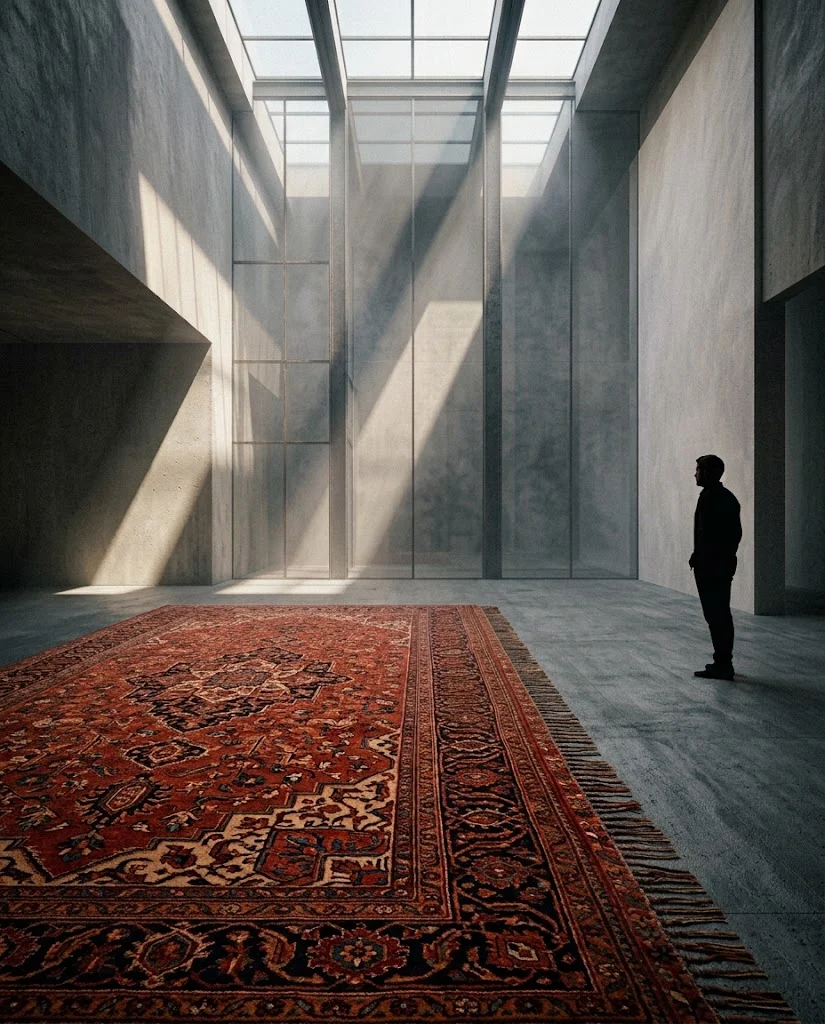
Applied Aesthetics of the Persian Carpet in Contemporary Interior Design
A practical framework for reading the Persian carpet as a design element: centre and border, rhythm, balance, scale and a seven-step method for choosing and placing it in contemporary interiors.
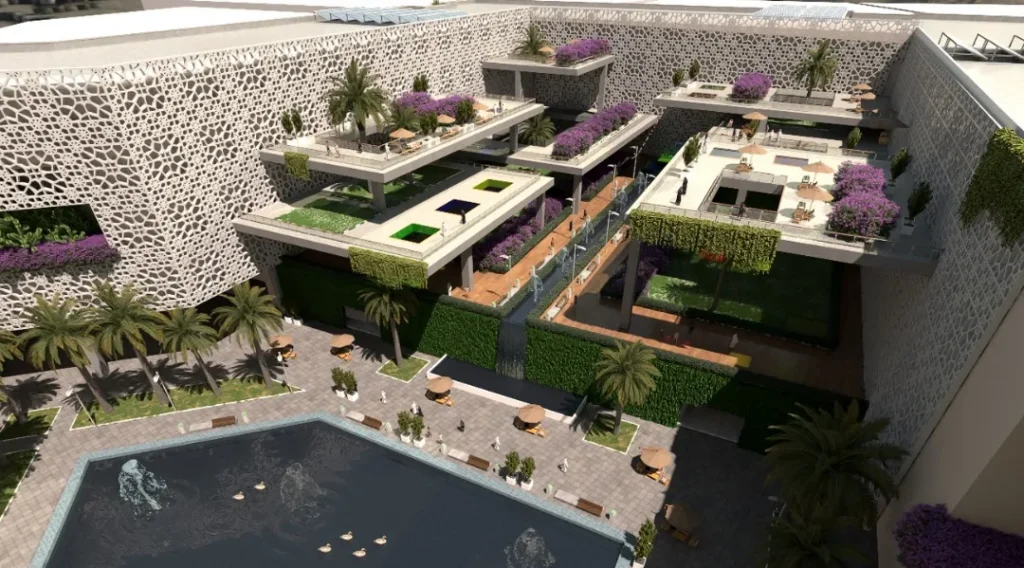
Reimagining Heritage: Islamic Geometry Meets Biophilic Design in Muscat
How a mixed-use building in Muscat turns Islamic geometric patterns into a shading facade and wraps a green courtyard of terraces, water and palms.

Design That Honours Many Cultures: Preserving and Sharing Heritage in Canada
Canada is home to people from every part of the world. How thoughtful design in homes, shops and public spaces can help preserve cultures and share them with neighbours.
LET’S DISCUSS YOUR PROJECT
Fill out the form and our manager will contact you for consultation.